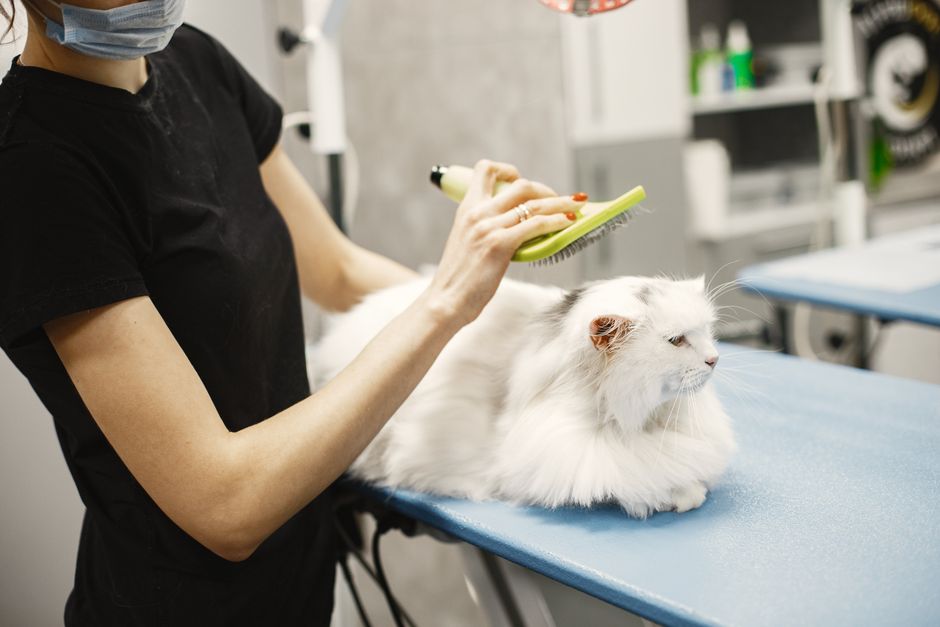
Let’s talk about a touchy, personal subject. Grooming. Yes, I know: I already spend four hours a day licking myself with flawless professional dedication. But sometimes, with mud, parasites, long fur, old age or plain bad luck, I need a helping paw. And that’s where your technique makes all the difference. Follow the guide, and nobody ends up in A&E.
Why grooming is my business (and a little bit yours)
My own grooming helps me regulate my temperature, keep my coat in shape, relax and mark my scent. When you help me out, you hit three targets with one swipe:
- 🐾 You remove the dead hair before I swallow it (and hand it back to you as a gelatinous gift on the carpet)
- 🐾 You spot early the fleas, lumps, sores or knots I so elegantly hide from you
- 🐾 You strengthen our bond, because a good brushing session is really just a cuddle in disguise
Brushing: the foundation of everything
How often?
- Short hair: 1 to 2 times a week
- Medium hair: 2 to 3 times a week
- Long hair (Maine Coon, Persian and friends): every single day, no negotiating
- During shedding season (spring/autumn): every day for everyone
Which brush should you choose?
Every coat has its own tool. A slicker brush – Amazon for long hair, a rubber brush – Amazon for short hair, and a de-matting comb – Amazon for the tricky spots (behind the ears, under the armpits, the back legs).
Baths: only when you really, truly have to
Let’s be clear: a healthy cat almost never needs a bath. The real exceptions are:
- A toxic or sticky substance on the coat (paint, oil, household cleaner)
- A flea treatment that calls for it, see my comparison of natural flea treatments
- An older or overweight cat who can no longer groom on their own
- Ringworm or a skin problem, on your vet’s prescription
The no-drama method, step by step
- Get everything ready first: towels, cat-specific shampoo (never yours!), a non-slip mat at the bottom of the basin.
- Cut the noise: no direct shower spray, fill the basin beforehand. Two inches of lukewarm water (37 °C) is plenty.
- Keep one hand resting on my shoulders, speak softly, move slowly.
- Avoid the head and ears: a damp cloth is enough for the face.
- Rinse thoroughly: any shampoo residue is going straight into my mouth when I lick myself afterwards.
- Dry me in a big warm towel, pat rather than rub. Hairdryer only if I’ll put up with it, on a warm and quiet setting.
Claws, eyes, teeth: the rest of the programme
The claws
Trim only the translucent tip, never the pink part (the quick, that bleeds and it hurts). A proper claw clipper – Amazon and a bit of patience: one paw a day if that’s what it takes, nobody said you had to do it all in one go.
The eyes
A clean pad soaked in saline solution, one eye = one pad. Coloured discharge or a closed eye → vet.
The teeth
Ideally: a brushing session with a cat-specific toothpaste – Amazon (never human toothpaste). Otherwise, dental treats and a good diet do part of the job, see my natural feeding guide.
The cat who hates it: your backup plan
- Desensitise gently: leave the brush near me for several days without using it.
- Keep sessions short: 2 minutes max at the start, then build up gradually.
- Calming pheromones 30 minutes before the session, details in my anti-stress guide.
- A grooming glove if the brush is my sworn enemy: a silicone glove – Amazon often goes down much better.
In a nutshell
Regular brushing matched to the coat, the occasional well-prepared bath, claws trimmed with care, and always the golden rule: gentleness, patience, treats. Your clean cat will thank you, by purring all over your keyboard.
Purrs, Sachat 🐾
Related reading
- Best cat brush: my comparison for the autumn moult
- Trimming your cat’s claws without a fight: Sachat’s guide
Frequently Asked Questions
How often should I brush my cat?
Short hair: 1 to 2 times a week; long hair: every day. During moulting, brush daily whatever the coat.
How do I trim a cat's claws?
Cut only the translucent tip, never the pink part that contains the quick. Use a suitable claw clipper, one paw at a time if needed.
Do I need to bathe a cat?
Rarely: it grooms itself. A bath is only useful in case of a toxic mess, a treatment or for an elderly cat.