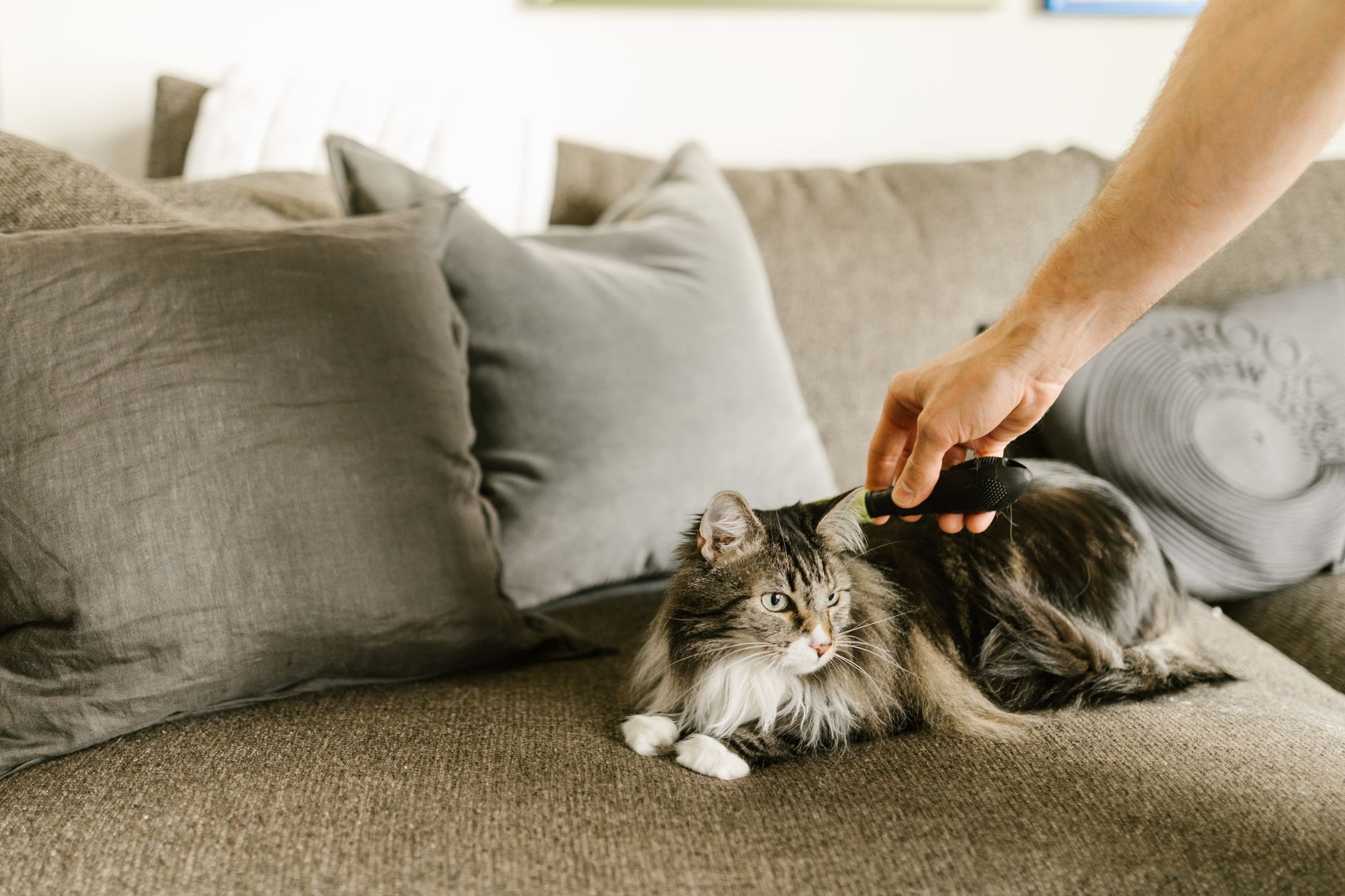
September arrives, the days shorten, and my body gets the signal: time to change coat. The autumn moult is quieter than the spring one, but it lasts longer, and it is the one that fills the house with fur right through to November.
So let me be blunt: a brush is not a comfort accessory. Every dead hair you take off is a hair I do not swallow while washing, and therefore one fewer hairball. I have tested four families of tool on my own back. Here is the verdict.
The table, for people in a hurry
| Tool | Best for | What it actually does | Rating found |
|---|---|---|---|
| Self-cleaning slicker | Short and medium coats | Lifts undercoat, empties at the push of a button | 4.5★ from 7,985 reviews |
| Undercoat rake | Long coats, dense undercoat | Opens knots, pulls out packed fluff | 4.5★ from 1,180 reviews |
| Rubber curry brush | Short coat, sensitive cat | Massages and lifts surface hair | 4.4★ from 3,190 reviews |
| Grooming glove | Cats who refuse a brush | Makes grooming feel like a stroke | 4.2★ from 527 reviews |
Ratings and review counts recorded on 25 August 2026. They move, so treat them as an order of magnitude.
1. The self-cleaning slicker: best effectiveness to effort ratio
This is the fine curved pin brush with a button that retracts the pins so the wad of fur lifts off in one go. If you only buy one, buy this one.
The self-cleaning slicker brush holds 4.5★ across nearly 8,000 reviews, which makes it the benchmark of the aisle. In practice it lifts the undercoat without tearing, and the button removes the tedious minute of picking hair out by hand.
What I like: it does not pull if you brush with the lie of the coat, and the one-press cleaning means you actually use it daily, which is the real criterion.
What bothers me: the metal pins sting if the human presses. On a thin or elderly cat, over the hips and legs, pressure needs to be minimal.
For whom: short and medium coats, cooperative cats, daily use.
2. The undercoat rake: essential on long hair
A single row of long, rounded teeth on a handle. It does not cut, it opens: it passes under the guard coat and pulls out the packed undercoat where knots begin.
I use an undercoat rake with rounded teeth, rated 4.5★ across more than 1,100 reviews. On a long coat in full moult, it lifts more undercoat in five minutes than a slicker manages in a quarter of an hour.
What I like: it is the only tool that really fixes the forming knots behind the ears, in the armpits and around the britches, before they become felted mats.
What bothers me: used badly, it pulls. Work in small sections, hold the base of the hair with your other hand, and never force through an established mat.
For whom: long coats, medium coats with dense undercoat, moulting season.
3. The rubber curry brush: the difficult cat’s favourite
A block of soft rubber with large rounded nubs. It does not reach deep undercoat, but it captures surface hair remarkably well, and above all it massages.
The soft rubber curry brush, 4.4★ across more than 3,100 reviews, is the one cats accept most readily. For a cat with a bad grooming memory, it is often the only tool that lets you start again from scratch.
What I like: it is physically impossible to hurt me with it, even if the human leans in. And the massage effect relaxes rather than tenses.
What bothers me: on a long coat it does almost nothing below the surface. It skates over the top.
For whom: short coats, sensitive or reluctant cats, rebuilding trust.
4. The grooming glove: the sneaky option
A silicone glove with nubs. Technically it is the weakest performer here. Strategically it is sometimes the only one that works.
The silicone grooming glove sits at 4.2★ across around 530 reviews, the lowest score in this comparison, and that is fair: it collects little. But a cat who flees a brush does not flee a hand. For kittens, nervous cats and sensitive areas like the belly, it opens a door nothing else opens.
What I like: I do not notice it is grooming. That is precisely the point.
What bothers me: throughput. In a real moult it is not enough on its own.
For whom: kittens, nervous cats, training, light upkeep.
So which one should you buy?
- Short haired, cooperative cat: the self-cleaning slicker, nothing else. Twice a week, daily in full moult.
- Long haired cat: the undercoat rake as the main tool, plus a slicker to finish. The pair really is necessary.
- Cat who hates being brushed: glove for a fortnight to rebuild trust, then rubber curry, then and only then the pin brush.
- Kitten: glove from the start. The aim is the habit, not the yield.
- Senior or thin cat: rubber first, the skin is thin and the bones prominent.
The method that avoids a fight
- Pick the moment: after a meal, while I am dozing, never straight after play.
- Start with strokes and slide the tool into the movement, no change of rhythm.
- Always with the lie of the coat, head to tail. Against it, it pulls and it annoys.
- Easy zones first: head, cheeks, upper back. Belly, legs and tail only once I am relaxed.
- Five minutes maximum at first. Stop before I complain, not after.
- Finish with a treat. Three weeks of that and I will come and ask for the brush.
The supplement that changes the moult
Brushing removes dead hair, but what I still swallow has to move through. Two simple helpers during the moult:
- A malt paste. Anti-hairball malt paste (4.3★ across more than 16,000 reviews) lubricates the gut and moves what is stuck. A hazelnut sized amount two or three times a week during the moult, not daily all year.
- Omega-3. A spoon of cold pressed salmon oil (4.5★ across more than 2,500 reviews) feeds the coat from the inside, reducing breakage and shedding. It is a background effect, visible after four to six weeks.
Final word
The autumn moult runs six to eight weeks. Five minutes a day with the right tool and you collect the fur on the brush instead of on the sofa, the jumpers and the rug. I get fewer hairballs and a quiet moment with you.
Nobody loses here, and for once I am not saying that just to get a treat.
Purrs, Sachat 🐾
Related reading
- Cat Hairballs: Prevention and Natural Solutions
- Cat Grooming: The Complete Stress-Free Guide
- Natural Cat Supplements: My Senior Top Picks
- My Cat Is Losing Fur: What to Do to Limit It
- Best Natural Cat Shampoo: My Top 5 Tested
- Trimming your cat’s claws without a fight: Sachat’s guide
Frequently asked questions
What is the best brush for a short haired cat?
A self-cleaning slicker with fine curved pins and a button to release the hair. It lifts the undercoat without tearing and empties in one gesture, which means it actually gets used daily. For a sensitive or reluctant cat, a soft rubber curry brush is easier to accept.
Which brush should I use on a long haired cat?
An undercoat rake with long rounded teeth as the main tool, finished with a self-cleaning slicker. The rake passes under the guard coat and pulls out the packed undercoat where mats form, behind the ears, in the armpits and around the britches.
How often should I brush a cat during the moult?
Daily for the six to eight weeks of the moult, five to ten minutes, against two or three times a week the rest of the year for a short coat. A long coat needs daily attention all year round, otherwise the undercoat felts.
My cat hates being brushed, what can I do?
Start with a grooming glove for a fortnight: the cat reads it as a stroke rather than a tool. Move on to a rubber curry brush, then only later to a pin brush. Keep sessions to five minutes, work with the lie of the coat, and always stop before the cat complains.
Is malt paste useful during the moult?
It genuinely helps swallowed hair pass through during moulting periods, at a hazelnut sized amount two or three times a week. It is not a year round daily supplement. A parallel course of salmon oil feeds the coat and reduces shedding at a deeper level.
Is heavy shedding always normal?
No. A moult is diffuse and even, with healthy skin underneath. Loss in patches, with redness, scabs or intense scratching, points to an allergy, a parasite or a hormonal disorder and needs a veterinary consultation.