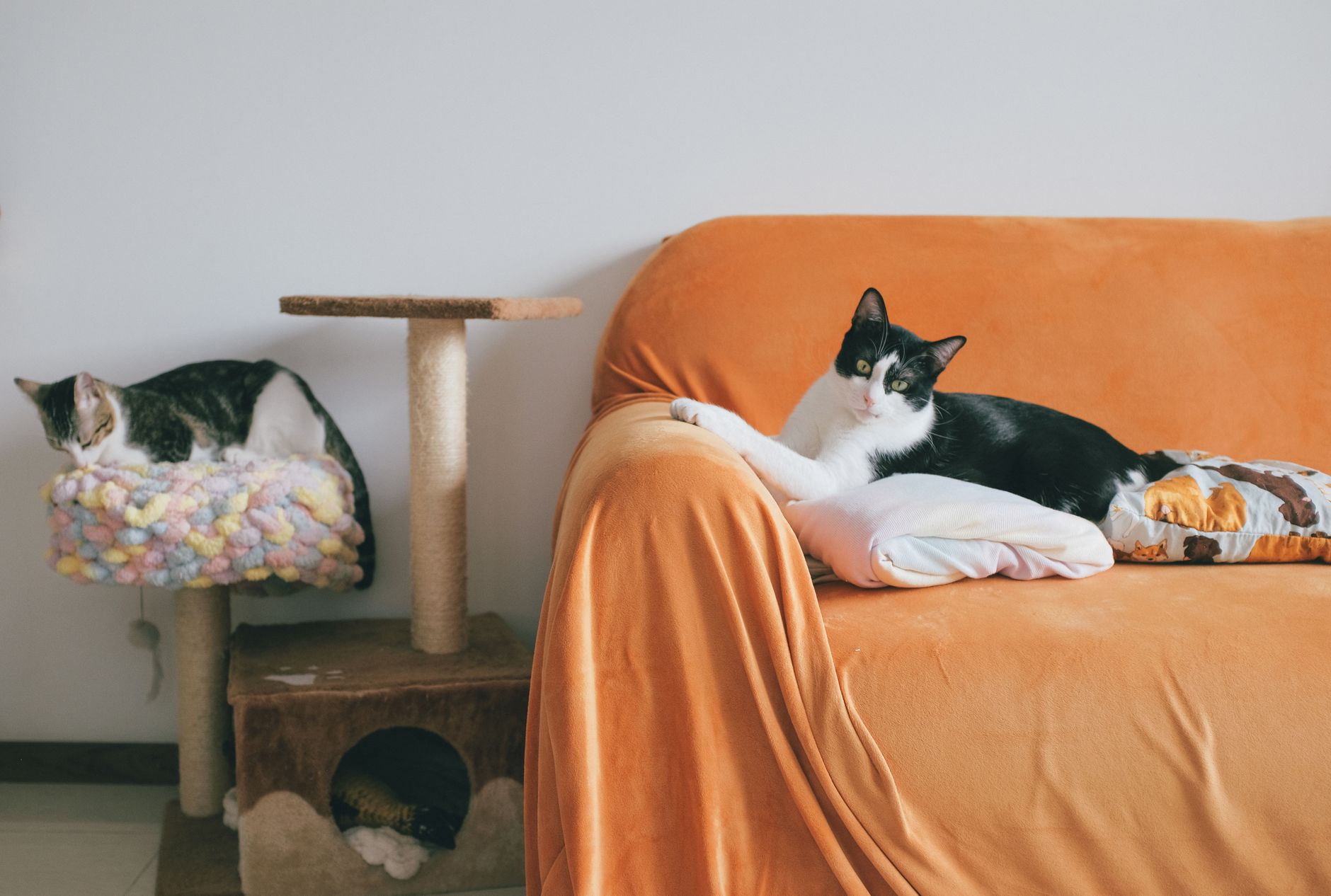
Right. You come home, you put down your keys, and there it is, the drama: your brand-new sofa is sporting some lovely parallel slashes, and the corner of your armchair looks like an old floorcloth. You look at me. I look at you. And you’re thinking very hard, “but WHY?”. Good news: I’m going to answer you, because yes, I’m the culprit, but no, I’m not doing it to annoy you. Scratching is part of me, it’s as natural as purring on your lap at 3 in the morning, exactly when you’re sleeping nicely.
Before you throw out your furniture or despair, understand one thing: a cat who scratches the furniture isn’t a nasty or badly behaved cat. It’s a cat who’s expressing himself. And with the right habits, we can save your sofa without frustrating me. Follow me, I’ll explain everything from the inside.
Scratching is in my genes (and it’s vital)
First thing to take on board: I don’t scratch IN ORDER to ruin your things. I scratch because I need to, deeply. It’s an instinctive behaviour that even my distant wild cousins practise on tree trunks. Your furniture just has the misfortune of being in the wrong place at the wrong time.
Maintaining my claws
When I scratch, I don’t “trim” my claws the way you file your nails. In reality, I’m removing the worn sheath that covers my claws to reveal the lovely sharp new layer underneath. It’s maintenance, home-grown polishing. Without a suitable surface, I’ll seek out the first texture that grips well: the fabric of your sofa, the wood of the table, the thick rug.
Marking my territory
My paw pads contain glands that leave a scent invisible to you. When I scratch a spot that’s clearly on show, I leave a double signature: a visual mark (the traces) and a scent mark. I’m telling the whole world, “this is my place”. That’s why I often choose strategic spots, near the entrance or beside your favourite armchair. It’s no accident, it’s communication.
Why MY furniture, MINE?
You’re wondering why I always go for the same corner of the sofa. The answer is simple: it’s handy, it smells good (you), and it’s smack in the middle of my kingdom. A cat likes to scratch where he lives, where he can see you. A scratching post hidden in a cupboard at the back will never interest me as much as a piece of furniture placed in the heart of the action.
There’s also the question of texture and height. I love stretching out to my full length and scratching upwards, it works my back and shoulders. A vertical sofa ticks all the boxes: tall enough, stable enough, and it doesn’t move when I grip it. If you offer me an alternative that brings these criteria together, the battle is half won.
Stress, boredom: when scratching becomes a signal
Sometimes, scratching more than usual hides something else. If I suddenly start shredding everything in sight, it may be that something is upsetting me. A house move, a new animal, a baby, a change of rhythm in the home: all of that can stress me, and scratching reassures me by re-marking a territory that feels threatened.
Boredom also plays a big part. A cat who spends eight hours alone with nothing to do will burn off his energy however he can, and that often ends up on your furniture. Regular play sessions change things dramatically. A simple natural ball for cats – Amazon that you roll along in the evening is often enough to drain my surplus energy, and so to cut down my urges for fabric massacre.
If despite everything I scratch in a truly compulsive way, accompanied by other signs (soiling, aggression, excessive grooming), don’t hesitate to mention it to your vet. A behaviour that changes abruptly always warrants making sure there isn’t an underlying health or anxiety issue.
The real solution: give me something better to scratch
Here’s the secret many humans miss: you CAN’T stop me scratching, and it’s pointless to try. What you need to do is REDIRECT that need towards a surface I’m allowed to destroy with pleasure. And that all comes down to the quality of the alternative.
A scratching post worthy of the name
The great classic, and for good reasons. A well-chosen cat tree – Amazon brings together everything I love: vertical sisal posts to stretch on, platforms to survey my domain from on high, and rock-solid stability. For it to work, respect three golden rules:
- Height: the post must let me stretch out fully, paws reaching upwards.
- Stability: if it wobbles when I scratch, I won’t come back to it. A heavy base is essential.
- Position: put it where I live, near the sofa I’m targeting, not in a forgotten corner. It’s counter-intuitive, but it’s the key.
Varying textures and angles
Not all cats have the same tastes. Some love scratching horizontally (on cardboard or a mat), others vertically. Watch me: if I always go for the floor or the rugs, offer me a horizontal surface. If I aim for the backrests and the corners, bet on vertical. Sisal, corrugated cardboard and raw wood are my favourite textures.
Protecting the furniture while I adapt
While I’m settling into my new habits, you can protect the sensitive areas. Temporarily cover the coveted corner with a material that doesn’t grip: a smooth throw, a well-stretched blanket, or some plastic film over the precise spot. The idea isn’t to punish me, but to make the furniture less satisfying to scratch while the cat tree becomes my new playground.
The pheromone helping hand
If I scratch mainly out of stress or to mark, a Feliway calming pheromone diffuser – Amazon can really help me feel safe. These pheromones reproduce a reassuring message and often reduce my need to re-mark the territory with my claws. Plugged into the room where I spend most of my time, it works gently, without forcing anything on me.
Maintaining my claws to limit the damage
Claws that are too long catch more and cause more damage. Regular upkeep with a good pair of cat nail clippers – Amazon shortens the pointy tip and reduces snags on the fabric. Go gently, only cut the clear tip and never the pinkish part (which is living and sensitive). If you’re not comfortable, ask your vet or your groomer to show you the technique the first time.
And above all: never any punishment
One last word, an important one. Don’t tell me off, don’t shout, don’t spray me with water when I scratch. To me, scratching is normal, so your anger seems unfair and baffling. Worse: it makes me anxious, and a stressed cat scratches even more. You’d get the opposite of the effect you’re after.
The good method is encouragement. When I use my cat tree, praise me, stroke me, give me a treat. I quickly understand what pleases you, and I love pleasing you (between two naps). With patience and the right set-up, your sofa will find peace again, and my claws will finally have a place all of their own.
FAQ
Should you declaw a cat who wrecks everything?
No, absolutely not. Declawing is a painful amputation, banned in many countries, and it deprives me of an essential part of my physical and mental balance. The solution is never to mutilate me, but to give me good alternatives to scratch. For any questions, your vet remains the best person to talk to.
My cat ignores his scratching post, what should I do?
Most often, it’s a matter of position or texture. Move it closer to the spot I actually scratch, choose a model that’s tall enough and stable, and rub a little catnip on it to draw my attention. Praise me every time I use it: positive association works wonders.
How many scratching posts do you need in the house?
Ideally several, spread across the rooms where I spend time. One scratching spot near my napping corner, another near the entrance or the sofa. The more well-placed alternatives I have, the less I’m tempted by your furniture.
Why does my cat scratch right after a nap?
Because it’s the perfect moment to stretch! Scratching after a rest lets me wake up my muscles and limber up my whole body. That’s why a scratching post placed near my sleeping spot is often a roaring success.
Purrs, Sachat 🐾