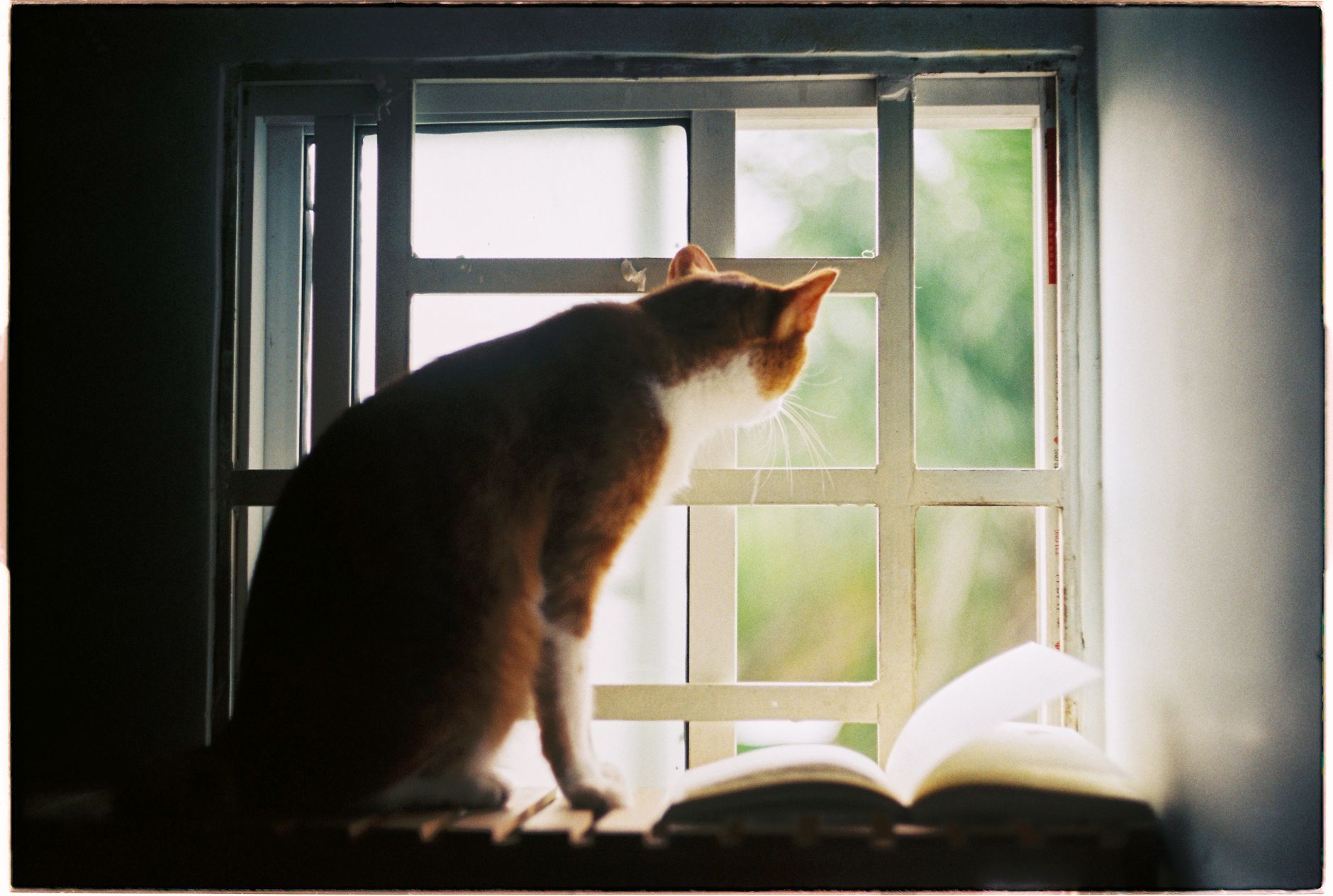
Two months. Two months of you being here, of noise in the flat, of legs to follow down the hallway, of three-in-a-row naps on the sofa and someone to open the balcony door on demand. Then one Monday morning it all stops. The house empties at 8am and does not fill up again until 7pm. Nobody warned me. Nobody asked my opinion.
September is the most abrupt change in my whole year. Not the cold, not the holidays: September. And plenty of humans miss it entirely, because a cat does not cry behind the door like a dog. We absorb it quietly, and it comes out sideways.
What actually changes for me
Cats are not solitary animals, whatever you have been told. I am territorial and deeply routine driven. What unsettles me is not your presence or absence in itself, it is the break in rhythm.
In July the house was full of markers: smells everywhere, movement, meals at loose hours, doors left open. In September everything freezes between 8am and 7pm. Add the children leaving, the suitcases vanishing, the furniture moved around, and my territory becomes unrecognisable.
Eight to ten hours alone is not a problem in itself. A cat sleeps 14 to 16 hours a day. The problem is eight hours alone in an environment that is empty, flat and offers nothing to do.
The signs that it is not going well
We do not howl and we do not bark. We tell you with our bodies. These signals usually turn up two to three weeks after term starts.
- Sudden house soiling in a previously spotless cat, often on a bed, a sofa or a rug. It is never revenge, it is anxiety looking for your scent.
- Excessive vocalising the moment you pick up your coat, or the second you walk back in.
- Compulsive over-grooming, sometimes to bald patches on the belly or inner thighs.
- New scratching on door frames and sofa corners, at eye level, along the routes you walk.
- Food gulped down in one go when you get home, or an untouched bowl all day.
- Wild evening energy, 10pm zoomies, night-time waking.
- Complete withdrawal: a cat who hides all day and stops coming to you. That is the most serious sign and the one most often ignored.
1. Do not go from zero to a hundred overnight
If you can plan ahead, start a week early. Go out for an hour, then two, then half a day. What I need to learn is not how to be alone, it is that your leaving is not an event.
Which brings me to the rule almost nobody follows: no ceremony. No long goodbyes in a sad voice, no lingering strokes on the doorstep, no theatrical reunion in the evening. That turns your departure into a drama and your return into a jackpot, and it manufactures exactly the anxiety you are trying to prevent.
You leave, you say nothing. You come back, you put your things down, and you greet me calmly five minutes later. Boring for you. Reassuring for me.
2. Open the house upwards
A 50 square metre flat is small measured across the floor. The same flat with three levels of accessible height becomes large. We do not measure territory in surface area, we measure it in volume and vantage points.
One cleared shelf, an accessible wardrobe top, a cat tree with high platforms next to a window: that alone transforms a day alone. A window seat over a busy street is a cat’s actual television, and it runs for eight hours straight.
3. Split the meals instead of filling the bowl
In the wild I would eat 10 to 20 small meals a day, each preceded by a hunt. One big bowl in the morning is the exact opposite: I clear it in ten minutes and then face ten empty hours.
- A programmable feeder. An automatic timed feeder set to four or five small meals cuts the day into chunks and gives me appointments. Check that it has battery backup for power cuts.
- Hidden portions. Stash three or four small servings around the flat before you leave. Under a mat, on a shelf, inside a punched cardboard box. You have just handed me a morning of work.
And water: put out at least two water points, well away from the food bowl. I drink little, and I instinctively avoid drinking next to my meat, a reflex inherited from ancestors who avoided water fouled by prey.
4. Toys that work without you
Honestly, most cat toys are useless without a human on the other end. The ones that work solo share one quality: they are unpredictable.
- A ball track. A ball in a closed circuit track keeps working instead of vanishing under the sideboard after thirty seconds.
- A tunnel. A collapsible play tunnel triggers ambush behaviour even alone, and doubles as a safe hiding spot.
- Natural materials. A matatabi chew sticks holds interest far longer than odourless plastic, because it has texture and smell.
- Cat grass. A pot of grow-your-own cat grass gives me an occupation and helps my digestion. It regrows in ten days.
5. Cardboard, free and unbeatable
I will be straight with you: given the choice between the ninety pound cat tree and the box your delivery came in, I often pick the box. Cut two holes in the sides, drop in an old t-shirt that smells of you, put it near a window. You have just built my favourite place in the house for nothing.
Your scent, in fact, is the best free anxiolytic there is. A worn, unwashed jumper left in my bed beats every gadget on the market.
6. Sound, but the right sound
Total silence in an empty flat is more stressful than people think. A radio at low volume on a speech station, or a calm playlist, softens the sudden noises of the building.
What does not help: loud music, television at full volume, and above all bird videos looping all day. Frustrated hunting on repeat, never catching anything, winds me up rather than occupying me.
7. Pheromones, when it is genuinely stuck
If stress signs are already established, a calming pheromone diffuser does help, provided you use it properly. Plug the calming pheromone diffuser into the room where I spend most of my time, never behind furniture or under an open window, and allow two to three weeks before judging.
It is not a medicine and it does not replace a decent environment. It is a nudge on top of changes you have already made. A diffuser in an empty, flat, featureless home will do nothing.
8. The evening quarter of an hour, non negotiable
If you take one thing from this article, take this one. Fifteen minutes of active play a day, split into two sessions if you can, beats every accessory in the shop.
Not stroking: hunting play. A wand toy, prey movement along the floor, pauses, and crucially a real catch at the end. A hunt that never succeeds frustrates. Finish with a treat or a meal, which completes the natural sequence: hunt, kill, eat, groom, sleep.
Do it when you get in, or right before your bedtime if I wake you at night. It solves a large share of night-time waking on its own.
9. Would a second cat help?
It is the advice you always hear, and it is right about half the time. Two young cats, introduced gradually, in a home with enough space and doubled resources: yes, that works beautifully.
A second cat dropped overnight on a settled eight year old territorial adult, in a small flat with one litter tray: that adds stress rather than removing it, and the cure becomes worse than the problem.
If you do try, apply the n plus one rule: as many litter trays, bowls, water points and beds as you have cats, plus one, spread around different rooms.
When nothing improves
Stress that persists beyond a month despite all of this, or comes with grooming to the point of broken skin, refusal to eat for more than two days, or systematic soiling, deserves a consultation. Veterinary behaviourists exist, and they work wonders where general advice runs out.
A cat who has not eaten for 48 hours is a genuine emergency, not a sulk: our livers cope very badly with fasting.
What I am actually asking for
Not a flat converted into a theme park. Just three things: height to observe from, a day cut into pieces instead of one long void, and fifteen minutes of hunting where you are fully present.
I will handle the rest. I still have fourteen hours of napping to fit in.
Purrs, Sachat 🐾
Related reading
- Natural Anti-Stress Solutions for Cats: Sachat’s Guide
- Natural Cat Toys: My Top 6 Picks (One Japanese Secret)
- Natural Cat Health: The Complete Guide
- Bored Indoor Cat: What to Do to Keep Him Busy
- Indoor Cat Exercise: 8 Ideas to Get Him Moving
- Cat-Proofing Your Home: A Pro’s Guide
- Indoor Cat Enrichment: The Complete Guide
Frequently asked questions
How long can a cat be left alone during the day?
Eight to ten hours is fine for a healthy adult cat, provided the environment is rich: height, vantage points, things to do and split meals. Beyond 24 hours with no human visit, someone needs to call in, if only for the litter tray and fresh water.
How do I know if my cat is struggling with being alone?
The commonest signs are sudden house soiling, vocalising as you leave, compulsive over-grooming to the point of bald patches, new scratching on doors, and wild energy in the evening. A cat who hides all day and stops coming to you is the most serious case.
Should I get a second cat for company?
It works well with two young cats introduced gradually in a home with enough space and doubled resources. Imposing a companion on a settled territorial adult in a small flat adds stress rather than relieving it.
Should I leave the radio or TV on for a cat alone?
A radio at low volume on a speech station softens sudden noises and reassures. Avoid loud volume and looping bird videos: a hunt that never succeeds frustrates the cat instead of occupying them.
Do calming pheromone diffusers work?
They genuinely help with established stress, provided they are plugged into the main living room, never behind furniture, and given two to three weeks. They are not medication: without changes to the territory alongside, the effect stays small.
My cat has started weeing on the bed since September, what should I do?
See a vet first to rule out cystitis or a urinary problem, both common and painful. If stress is confirmed, clean without ammonia or bleach, add a second litter tray in a quiet spot, and work on enriching the territory.