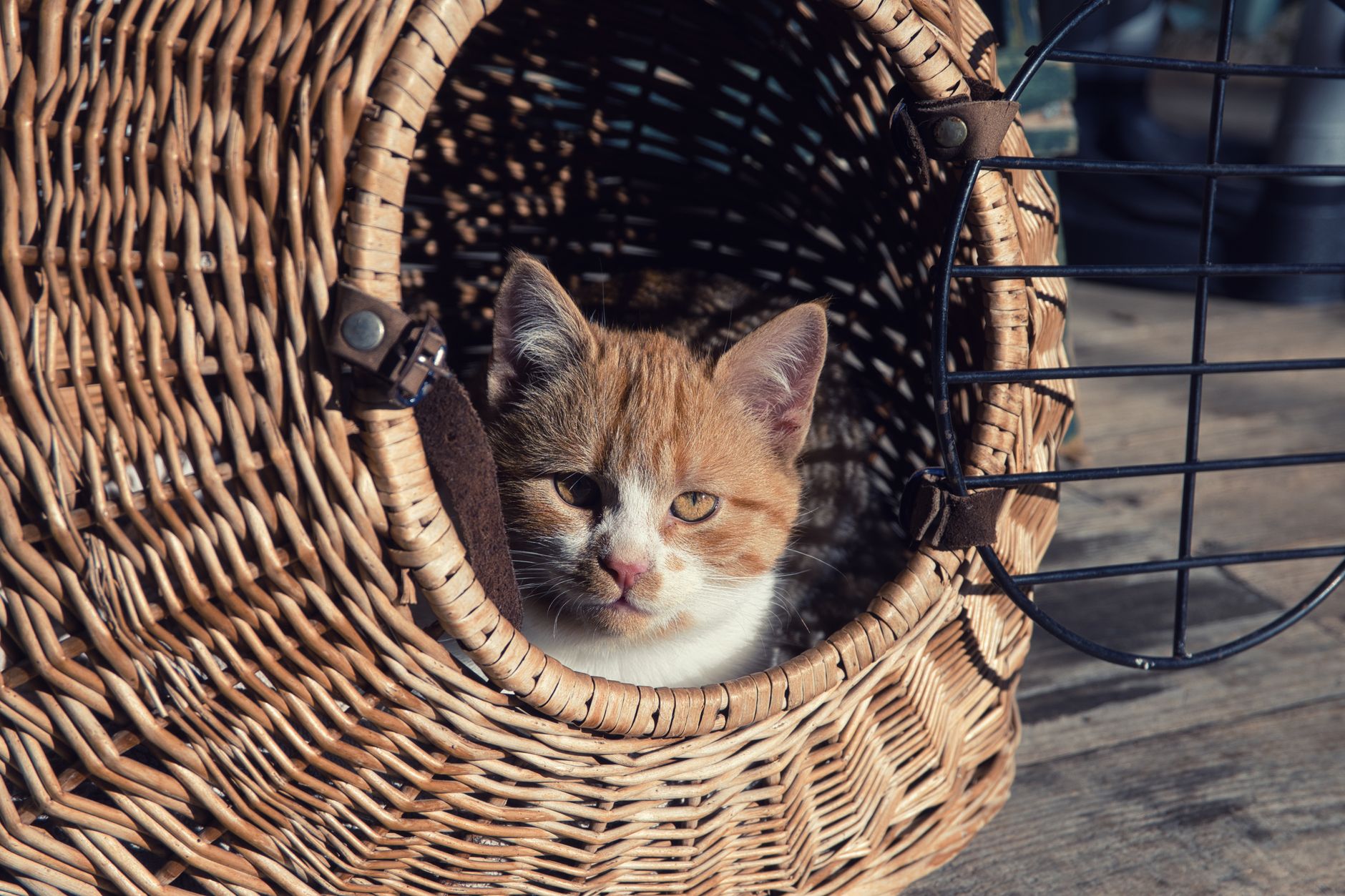
Hi, it’s Sachat. Let’s talk about the moment nobody enjoys: you get the carrier out, I vanish under the bed, and fifteen minutes later you have three scratches on your forearm and a missed vet appointment.
Here’s the thing, none of that is inevitable. The problem is almost never the cat. It is the carrier, and above all how it gets used.
I went through eight models listing by listing, and I am giving you the full method to get me in there on my own. Honestly, it works.
Size: the same rule as my litter tray
A decent carrier is 1.5 times my length, nose to the base of the tail. I need to stand up without ducking my head, and turn round without a three-point manoeuvre.
Too big is no better, mind: I get thrown around at every corner. A carrier where I touch the sides when I lie down feels reassuring. It is a den, not a flat.
Before buying, measure your cat lying stretched out, from nose to the base of the tail, and multiply by 1.5. A 45 cm cat needs a 68 cm carrier. Most models on sale run 44 to 50 cm, so they suit smaller cats and anything up to about 5 or 6 kg.
The one feature that changes everything: a top opening
If you take one thing from this article, take this.
With a front-door-only carrier, here is what happens. You present the entrance, I see a dark tunnel, I spread my legs and brace against the sides. You push. I brace harder. You end up shoving me in from behind, I panic, and I scratch. You follow me?
With a top opening, everything changes. You lift me calmly, lower me in bottom first, and close the lid. Three seconds. I never had to look down a tunnel, so I never had the chance to dig my heels in.
Coming home from the vet it works the same in reverse: open the top and let me come out when I am ready, instead of tipping the thing up to shake me out of the door.
Hard or soft?
A hard carrier protects better in a crash, cleans up in two minutes if I am sick on the way, and does not sag when you put it down. It is the default choice for the vet and the car.
A soft bag is lighter, folds flat, and fits under an aircraft seat. On the other hand it deforms, it holds smells, and it will not protect me from an impact. Buy one for travelling, not for everyday trips.
The models, and what the reviews actually say
Good news, and it is a change from the harness aisle: here, four models clear both of my thresholds, 4.5 stars minimum and at least a hundred reviews.
| Model | Type | Rating found | Reviews | One-star buyers |
|---|---|---|---|---|
| Morpilot soft carrier | soft | 4.7★ | 53,408 | 2 % |
| MDC top-opening carrier | hard | 4.7★ | 283 | 1 % |
| Amazon Basics two-door | hard | 4.6★ | 63,795 | 1 % |
| pecute airline-approved bag | soft | 4.6★ | 1,467 | 2 % |
| Ferplast carrier | hard | 4.4★ | 2,313 | 7 % |
| Ferplast Atlas 10 | hard | 4.3★ | 832 | 6 % |
| Ferplast Atlas Deluxe | hard | 3.9★ | 273 | 9 % |
Look at the Amazon Basics row. 4.6 stars across nearly 64,000 reviews, with 1 % of buyers leaving one star. One in a hundred. At that volume it is almost unreal, and it is the strongest figure in any comparison I have run, litter boxes and feeders included.
The one I recommend
The Amazon Basics two-door carrier. Its listing specifically mentions a top door with a handle and latches, on top of the front door, which is exactly what we are after. The two halves screw together, so it will not pop open if you carry it badly.
If you want better and the budget allows, the MDC top-opening carrier shows 4.7 stars and 1 % unhappy buyers, with mesh sides so I can watch the world go by. Fewer reviews, but the best profile of the lot.
For flying
The pecute cabin-approved bag: 44 × 30 × 23 cm, cats up to 5 kg, a steel frame so it does not collapse under the seat, openings on both the top and the side, and an internal tether to clip to my collar. Do check your airline’s exact dimensions before you book, because they differ from one carrier to the next.
For bigger cats, the Morpilot bag takes up to 8 kg at 44 × 31 × 34 cm, with a strap to secure it in the car. 4.7 stars across more than 53,000 reviews.
The method that gets me in on my own
Kit is only half the job. The other half is undoing the equation “carrier equals vet equals needle”. Allow two to three weeks, five minutes a day.
Week 1: the carrier never goes back in the cupboard
You take it out and leave it out. In the living room, door open or split into two halves, with a blanket that smells of home inside.
The aim is for it to become furniture. Something I walk past ten times a day without a thought. As long as it only appears twice a year, it stays an alarm bell.
Weeks 1 and 2: everything good happens inside it
Treats go inside. Catnip goes inside. You play with the wand and finish the game inside. Nothing unpleasant ever happens in there. Ever.
You do not push me, you do not even call me. You put something down and walk away. Curiosity does the rest, it is our weakness.
Week 2: close the door for ten seconds
Once I go in by myself, shut the door for ten seconds and open it before I ask. Thirty seconds the next day. Then a minute. If I start crying, you went too fast: drop back a step without making a fuss about it.
Week 3: a trip round the block
Carry me in the carrier to the car, start the engine, drive round the block and come home. With no vet at the end of it. Everyone skips this step, and it is the one that breaks the “car equals needle” link.
On the day
A spray of pheromones inside the carrier twenty minutes beforehand, the usual blanket, and a towel draped over the carrier for the journey. In the dark I settle myself.
And if it has to happen right now?
Because sometimes there are not three weeks. There is an appointment in an hour and a cat under the bed.
The towel technique
Take a big bath towel. Approach me calmly, from the side, never head on. Lay the towel over my back and shoulders, wrap without squeezing, legs included, and lift me in one piece.
Then lower me into the carrier through the top, bottom first, towel and all. The towel stays with me, it smells of you, that is a good thing.
It works because a wrapped cat can neither scratch nor brace against the sides. And nobody gets hurt.
Never drag me out from under the bed by a leg, never grab me by the scruff (I am not a kitten any more, it hurts and it does not immobilise me), never shove me in backwards through a front door, and never shout. A cat who has been frightened once takes ten times longer the next time.
In the car, two minutes of setup
- Never on your lap, never loose. In a 50 km/h emergency stop, a 4 kg cat becomes a projectile of more than 100 kg.
- Strap the carrier down. Run the seatbelt through the handle or the fittings provided, or wedge it in the footwell behind a front seat.
- Flat and stable. No sloping seat, no boot where I can see nothing.
- Covered with a towel, but out of direct sun: a car cabin heats up fast, and heatstroke takes minutes. I cover that in my guide to heatstroke in cats.
- No food for two hours before if I get car sick.
In short
A carrier that opens from the top, 1.5 times my length, left out in the living room permanently. Do that and you have solved 90 % of the problem.
The rest is patience: three weeks at five minutes a day, and one car trip that does not end at the vet. Truth is, it is the best return on investment of your entire career as a cat servant.
If you want to go further and take me everywhere, the kit side is in my guide to harnesses, collars and GPS trackers, and the training side is in my guide to the travelling cat.
Purrs, Sachat 🐾
Frequently asked questions
What size cat carrier do I need?
About 1.5 times the length of the cat, nose to the base of the tail. He should be able to stand without ducking and turn round without forcing. A 45 cm cat therefore needs a carrier around 68 cm long. Bigger is not better: the cat gets thrown about at every corner, whereas a snug space reassures him.
How do I get a cat into a carrier without being scratched?
Lower him in through a top opening, bottom first. A front door alone is the number one cause of scratches: the cat sees a tunnel, spreads his legs and braces against the sides. In an emergency, wrap him in a big bath towel, legs included, lift him in one piece and lower the whole bundle into the carrier.
Should I leave the cat carrier out all the time?
Yes, and it is the single most effective tip here. A carrier that only appears twice a year becomes an alarm bell. Left in the living room with the door open, a familiar blanket inside and treats appearing in it, it turns into just another bed within two or three weeks.
Hard carrier or soft bag for a cat?
A hard carrier protects better in a crash, cleans easily and does not sag: it is the right choice for the vet and the car. A soft bag is lighter, folds flat and fits under an aircraft seat, but it deforms and protects less. For everyday use buy hard; for travelling, buy a cabin-approved soft bag.
How do I secure a cat carrier in a car?
Run the seatbelt through the handle or the fittings provided, or wedge the carrier flat in the footwell behind a front seat. Never on your lap and never loose: in a 50 km/h emergency stop, a 4 kg cat develops the energy of more than 100 kg.
My cat cries and drools in the car, what can I do?
Cover the carrier with a towel, as darkness calms most cats. Avoid feeding him in the two hours before you set off, and make short trips with no vet at the end to break the association. If the drooling is heavy or comes with vomiting on every journey, speak to your vet: there are treatments for motion sickness.