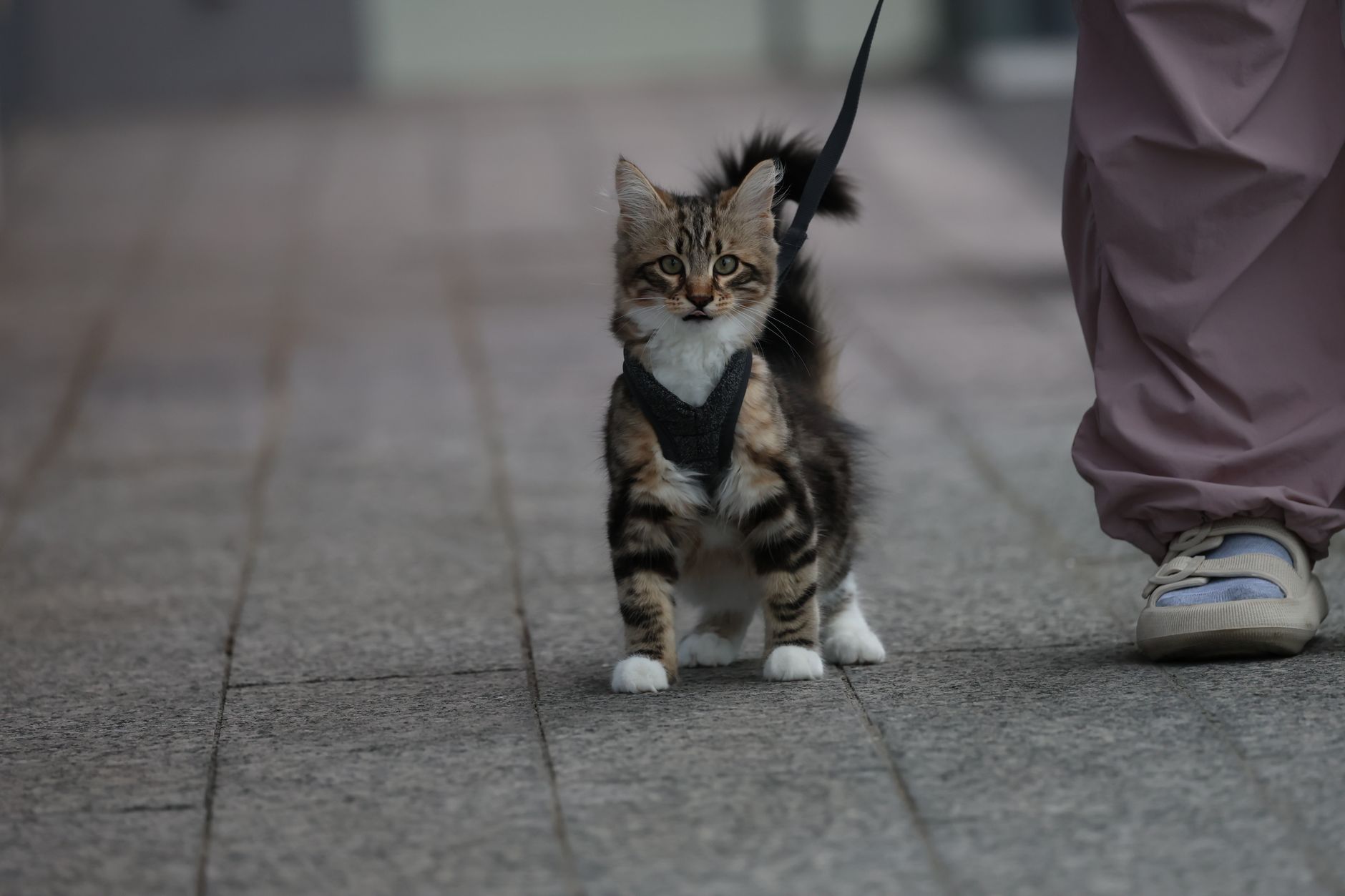
Hi, it’s Sachat. You want to take me outside safely, or simply sleep knowing where I am wandering. So you start looking at harnesses, collars and GPS trackers.
I opened eighteen product listings and noted three numbers on each: the rating, the number of reviews behind that rating, and the share of buyers who left a single star.
Truth is, the result is not the one I expected. On the tracking side it is frankly poor.
The collar: one rule, and it is not negotiable
Before the style, before the bell, before the colour matching your sofa: a breakaway buckle, also called a safety or quick-release buckle.
The principle is simple. If my collar catches on a branch, a fence or a window handle, the buckle gives way under my weight and I drop to the ground. Without it, I hang there. It happens, and it kills cats every year.
A collar without a breakaway buckle must never stay on a cat who goes outside, nor on an indoor cat with access to a balcony or high furniture. This is not a comfort detail, it is the difference between an incident and a fatal accident.
Second point: the fit. Two fingers should slide between the collar and my neck. Not three, or I get my head out. Not one, or I cannot breathe properly.
And the collar is not for walking me. Never clip a lead to a collar: every bit of pull lands on my windpipe. For going out it is a harness, and nothing else.
The harness: the shape matters more than the brand
There are three shapes on the shelf, and they are nowhere near equal when I decide to reverse out.
The H, the Y and the vest
- The H harness: two loops joined by a strap. It is the best seller, it is the cheapest, and it is the one I escape from most easily. A panicked cat flattens himself, backs up and slips out. You follow me?
- The Y harness: the chest strap runs down in a point between my front legs. It restricts my shoulders less, so I put up with it better over time.
- The vest: a jacket covering chest and flanks. It is the hardest to get out of, because the pressure spreads instead of concentrating on two straps. It is also the warmest in summer, so your call.
Honestly, if you are starting from scratch, buy a vest or a Y. The H is a guaranteed escape the day a dog barks.
The two-finger test, then the corridor test
A properly fitted harness leaves two flat fingers under each strap. Then do the corridor test: harness on, lead in hand, and back away slowly while calling me. If I reverse out of the harness in your hallway, I will reverse out of it outside too, except there will be a road.
What the models are actually worth
And here, bad news. I checked five harnesses, and not one reaches 4.5 stars.
| Model | Rating found | Reviews | One-star buyers |
|---|---|---|---|
| rabbitgoo with neck buckle | 4.4★ | 414 | 5 % |
| PetThem escape-proof | 4.3★ | 2,602 | 6 % |
| rabbitgoo classic | 4.2★ | 60,659 | 6 % |
| LucyBalu Explorer (AirTag pocket) | 4.2★ | 225 | 6 % |
| Tierhood escape-proof | 4.0★ | 1,148 | 9 % |
The column that matters is the last one. The rabbitgoo classic shows 4.2 stars, which impresses nobody. Except that it is across more than sixty thousand reviews, with 6 % of buyers genuinely disappointed. An average rating on that volume is worth a thousand perfect scores on twelve reviews.
If you want the best profile on the shelf, it is the rabbitgoo with a neck buckle: 4.4 stars across 414 reviews and only 5 % at one star. Less hindsight, but the best hold.
The GPS tracker: this is the weak spot
GPS and Bluetooth are not the same thing at all
The shelf mixes two technologies that have nothing in common, and that is trap number one.
A real GPS carries a satellite chip and a SIM card. The tag works out its own position by listening to satellites, exactly like your phone, then sends that position over the mobile network. Hence the SIM, and hence the subscription.
So it needs two things at once: a view of the sky, and mobile coverage. Under a garden shed or in a cellar, the position degrades.
A Bluetooth tracker, AirTag style, has no idea where it is. It simply broadcasts “I am here” on a loop and waits for an iPhone to pass within range. That phone then relays the position, anonymously and encrypted, to the owner.
So everything depends on footfall. In a city centre, where there is an iPhone every ten metres, the position refreshes every few minutes. In a hamlet or at the edge of a wood, you can be stuck on “yesterday, 5 p.m., outside the bakery”.
Which means all those devices sold as “GPS, no subscription” for twenty or thirty pounds are Bluetooth trackers. The word GPS is on the label; the chip is not inside.
What the buyers say
| Model | Type | Rating found | Reviews | One-star buyers |
|---|---|---|---|---|
| Breakaway collar with AirTag holder | Bluetooth | 4.0★ | 12,962 | 13 % |
| Weenect Cat XS | GPS + sub | 3.9★ | 1,883 | 11 % |
| Tractive Cat Mini 2026 | GPS + sub | 3.7★ | 209 | 22 % |
| Tractive Mini | GPS + sub | 3.1★ | 2,546 | 18 % |
Read that last line properly. Tractive, the world reference in cat trackers, sits at 3.1 stars across 2,546 reviews, with 18 % of buyers leaving one star. Almost one in five. Its 2026 edition manages 3.7, but with 22 % at one star.
The whole category is poorly rated. This is not one brand disappointing, it is the aisle.
And I wear one, so let me be fair
I wear a Weenect round my neck every day, and honestly it does the job. So I read the negative reviews to understand the gap.
The main complaint is not about the tracking itself, which works. It is about two other things: the geofence alerts, meant to warn you when the cat leaves an area and which fire unreliably, and the cost of the subscription, which many buyers discover after paying for the device. A few reviews also mention units running hot.
Put plainly: if you want to find a lost cat, it works. If you want a virtual fence that warns you in real time, you will be disappointed. That distinction changes everything, and no product page will tell you.
Weight and battery, the parts nobody checks
A GPS tracker for cats weighs 25 to 35 grams. That sounds like nothing, except that on a 4 kg cat it is the equivalent of half a kilo hanging round your neck all day. An AirTag weighs 11 grams, about 20 with its holder.
Battery is the real tipping point. A GPS lasts two to seven days depending on how often it reports: you have to remember to charge it, and a flat tracker is worth precisely nothing on the day the cat disappears. A Bluetooth tag runs about a year on a coin cell. You forget it exists, which is exactly what you want from it.
Worth noting too: the second-generation AirTag shows 4.6 stars across 5,435 reviews with 6 % of buyers at one star. By a distance, the best rated item in this whole comparison.
What I would buy, case by case
Indoor cat with a balcony or windows
A breakaway collar, and nothing else. No tracker, you have no use for one. Put the budget into netting instead, which I cover in my guide to cat-proofing a balcony.
You want to walk me on a lead
The rabbitgoo with a neck buckle, the best profile on the shelf. And take your time over the habituation, because no harness will hold otherwise.
Cat who goes out in town
A second-generation AirTag slipped into a breakaway collar with an AirTag holder. In town the density of phones does all the work. One payment, no subscription, no charging. And it is the best rated product in my whole survey.
Cat who goes out in the countryside
Bluetooth is no longer enough: with nobody around, there is no position. You need a real GPS.
The Weenect Cat XS is the one I wear, and I recommend it without reservation for what it actually does: find a cat. Its 3.9-star rating is harsh next to daily use, but it says something true about the geofence alerts and the subscription, so go in knowing that.
Before buying anything, check that my microchip is registered to your name and your current address on the national database. It is free, it takes five minutes, and it is what brings me home in the vast majority of cases. A tracker runs flat or falls off; the chip does not.
In short
A breakaway collar is non-negotiable. The harness should be a vest or a Y, never an H, and nobody on the shelf gets past 4.4 stars.
The tracker is the disappointment of this survey. The world reference sits at 3.1 stars with nearly one buyer in five very unhappy. If you live in town, an AirTag often does better for a fraction of the cost.
And kit is nothing without training. A cat strapped into a harness for the first time at three years old will never go out calmly, whereas a kitten brought along gently will follow you anywhere. That is the whole subject of my guide to the travelling cat. And if your current problem is getting me to the vet with your forearms intact, that is in my guide to the cat carrier.
Purrs, Sachat 🐾
Frequently asked questions
Can you attach a lead to a cat's collar?
No, never. All the pull would land on the windpipe, which is far more fragile than a dog's. A collar is for carrying an identity tag or a tracker, not for guiding. To go out you need a harness that spreads the pressure across the chest and flanks.
Which cat harness is hardest to escape from?
The vest, which covers chest and flanks, then the Y shape. The H harness, the cheapest and best selling, is the one a panicked cat slips out of most easily by reversing. Across the five models checked in October 2026, none reached 4.5 stars, and the most frequent complaint in the reviews is precisely escape.
Do no-subscription GPS trackers actually work?
They are not GPS trackers. A real GPS needs a SIM card, and therefore a subscription. The devices sold without a subscription are Bluetooth tags: they do not know their own position and rely on passing phones to relay it. In town that often works well; in the countryside it barely works at all.
Which GPS tracker should I choose for a cat?
None of them gives real satisfaction, and that is the clearest finding of this survey. Tractive, the market reference, shows 3.1 stars across 2,546 reviews with 18 % of buyers at one star, and its 2026 edition rises to 22 %. The least poorly rated is the Weenect Cat XS at 3.9 stars across 1,883 reviews. The complaints centre on battery life, the geofence alerts and the weight of the unit.
Won't a breakaway collar get lost?
It will, and that is exactly its job. Far better to buy another cheap collar than to find your cat hanged from a branch. Keep two spares, and treat the microchip as the real safety net.
At what age should a cat get used to a harness?
As early as possible, ideally between 8 and 16 weeks, during the window when everything a kitten meets becomes normal to him. Past a year the training is still possible but takes far more patience, and some adult cats will simply never accept it.