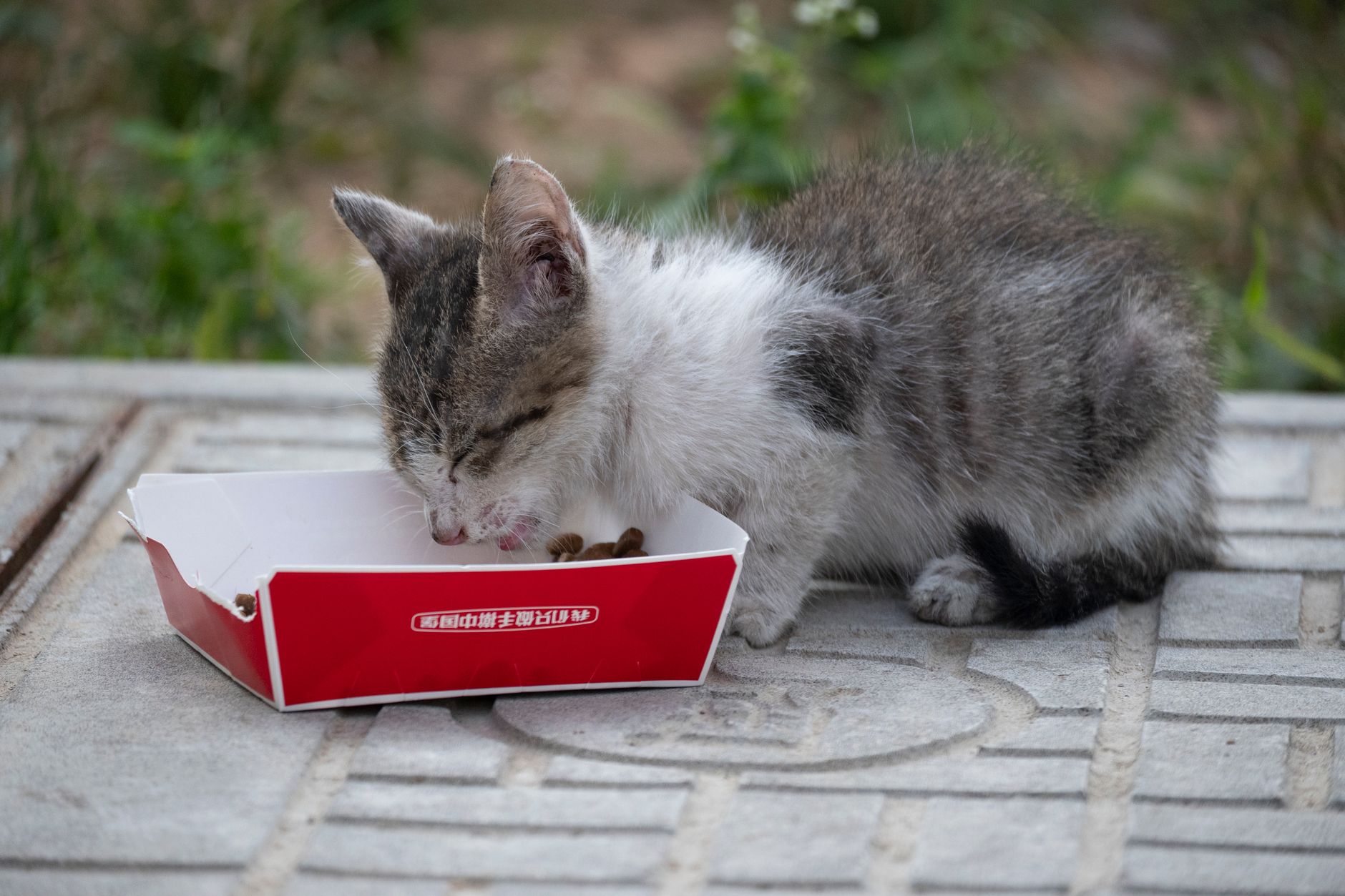
Hello, it’s Sachat! Have you just taken in (or are you about to take in) a tiny ball of fluff still suckling its mum or a bottle? Then let’s talk about a crucial moment in a kitty’s life: weaning. Believe me, I’ve seen plenty of clumsy kittens plant their whole muzzle in the bowl instead of eating. It’s adorable, but it does need preparing for. Weaning a kitten isn’t just “take away the milk and off we go”, it’s a gradual transition that affects their health, their weight, and even their character later on. Settle in, I’ll explain it all, step by step, with the tips of a seasoned old tomcat.
What exactly is weaning?
Weaning is the move from a 100% milk-based diet (mum’s milk or a milk replacer) to the solid food of a miniature adult. But be warned, it’s not just about the bowl: it’s also an emotional and behavioural weaning. The kitten learns to detach from its mother, to explore, to groom itself, to use the litter tray. All of that plays out over a few short weeks.
Wean too early or carelessly, and you end up with an anxious cat who suckles blankets at the age of 3 (yes, it happens, I know a few), or who has digestive troubles. Wean well, and you lay the foundations of a balanced, thriving cat. It’s well worth taking it slowly.
At what age do you wean a kitten?
The big question! Here’s the natural timeline, the one mother cat follows on instinct:
- 0 to 3 weeks: milk-only diet. The kitten suckles, sleeps and grows. We don’t touch a thing.
- 3 to 4 weeks: weaning begins. The first teeth come through, and so does curiosity. This is the time to introduce softened solid food.
- 5 to 7 weeks: active transition. The kitten eats more and more solids and suckles less and less.
- 8 to 10 weeks: full weaning. The kitten is completely independent when it comes to food.
The golden rule I keep hammering home: a kitten should NEVER leave its mother before 8 weeks, and ideally not before 12 weeks. It’s even the law in plenty of places. Before that, it misses out on essential learning (toilet training, social codes between cats, inhibited biting). If you’re offered a 6-week-old kitten “ready to go”, be wary.
And if you’re raising an orphan kitten?
In that case, you’re mum. You feed with a special kitten milk replacer (never cow’s milk, it gives them diarrhoea!), from a bottle, every 2 to 3 hours in the first few weeks. Then you follow exactly the same weaning timeline from 3 to 4 weeks onwards. Patience and consistency, that’s the key.
The practical stages of food weaning
Stage 1: the starter “soup” (3 to 4 weeks)
We don’t throw hard kibble at a kitten that has barely any teeth. We start with a gruel: mix special kitten kibble (or wet food) with warm milk replacer or warm water, until you get the texture of a thick soup. Serve it in a shallow plate. At first, the kitten will walk in it, sneeze, do all sorts. That’s normal! It’s discovering.
As for the dish, forget the plastic that holds onto smells and sometimes causes chin acne. A shallow ceramic bowl – Amazon is perfect: stable, hygienic, and easy to clean.
Stage 2: thickening gradually (5 to 6 weeks)
Over the days, you reduce the amount of liquid. The soup becomes wet food, then wet food with a few softened kibbles, then barely moistened kibble. The kitten learns to chew. Its milk teeth are all in, so it can get stuck in.
Choose a quality food, rich in animal protein, suited to growth. A kitten has enormous energy needs. I’m rather fond of grain-free, very meaty wet foods like Almo Nature – Amazon for the wet phase, and when it comes to kibble, a premium meat-rich formula like Orijen – Amazon works wonders on the coat and energy of the little ones.
Stage 3: solids for good (7 to 8 weeks)
The kitten now eats its solid food without it being moistened. It still suckles its mother a little for comfort, but most of the calories come from the bowl. Offer several small meals a day (4 to 5 meals), because a little tummy can’t store much. Always leave fresh water available, in a separate bowl from the food.
Supporting the kitten’s digestion and comfort
Changing diet is a little upheaval for brand-new intestines. Passing soft stools is fine. But if it lasts, slow the transition down.
To help the gut flora settle in during this sensitive period, probiotics for cats – Amazon can really smooth the transition and limit stress-related diarrhoea. And to perk up a reluctant appetite a little or give the coat a boost, a few drops of salmon oil – Amazon in the wet food makes the bowl irresistible. My whiskers quiver just thinking about it.
Behavioural weaning: not just the food bowl
We often forget it, but weaning is also a whole apprenticeship in cat life. During this period, the kitten:
- Learns to be clean: place a low, accessible litter tray near its bed. Instinct does the rest, it generally copies its mother.
- Learns to play and to hold back: the tussles with its brothers and sisters teach it inhibited biting. That’s exactly why you mustn’t separate it too soon.
- Learns to reassure itself: a calm, stress-free environment is essential. A soothing pheromone diffuser like Feliway – Amazon can help the kitten (and you) get through this transition and the arrival in a new home more serenely.
If you adopt your kitten at around 8 to 12 weeks, it’s usually by then that all of this is in place. Your job is to gently keep up these good habits in your home.
The mistakes not to make
- Giving cow’s milk: a classic, and a big blunder. Kittens digest lactose poorly. Special kitten milk replacer only.
- Going too fast: rushing the stages causes digestive stress and deficiencies. Weaning takes several weeks, not several days.
- Separating the kitten from its mother too soon: before 8 weeks, it’s a no. You sacrifice its future balance.
- Adult food: a kitten doesn’t have the same needs. It needs a “growth” or “kitten” formula until around 12 months.
FAQ
From what age can a kitten eat dry kibble?
Around 6 to 7 weeks, when its milk teeth are well through and it has got used to increasingly solid textures. Before that, offer it kibble softened with a little water or warm milk replacer. The transition to fully dry food happens gently, over one to two weeks.
My kitten still suckles a blanket, is that serious?
It’s often a sign of slightly early weaning or a need for comfort. It isn’t dangerous in itself, but keep an eye out that it doesn’t swallow any fibres. Give it emotional security, hiding spots, a stable environment, and the behaviour generally eases off over time. A soothing diffuser can help.
How many meals a day during weaning?
A kitten has a tiny tummy and big energy needs. Aim for 4 to 5 small meals a day during weaning and growth. You can gradually cut down to 2 to 3 meals as it grows. Fresh water, for its part, stays available at all times.
Should you keep up the milk replacer once weaning has begun?
You can keep it alongside at the very start (3 to 5 weeks) to ensure intake while the kitten learns to eat solids. Then you reduce it gradually as the share of solid food increases. By around 7 to 8 weeks, the milk replacer is in principle no longer needed.
There you go, you know everything you need to guide your little charge towards independence. Take it gently, observe them, adapt the pace to THEIR pace, and you’ll have a sturdy, serene cat. And if you have any doubt about their health or weight during weaning, off to the vet: better one question too many than a problem left to drag on.
Purrs, Sachat 🐾