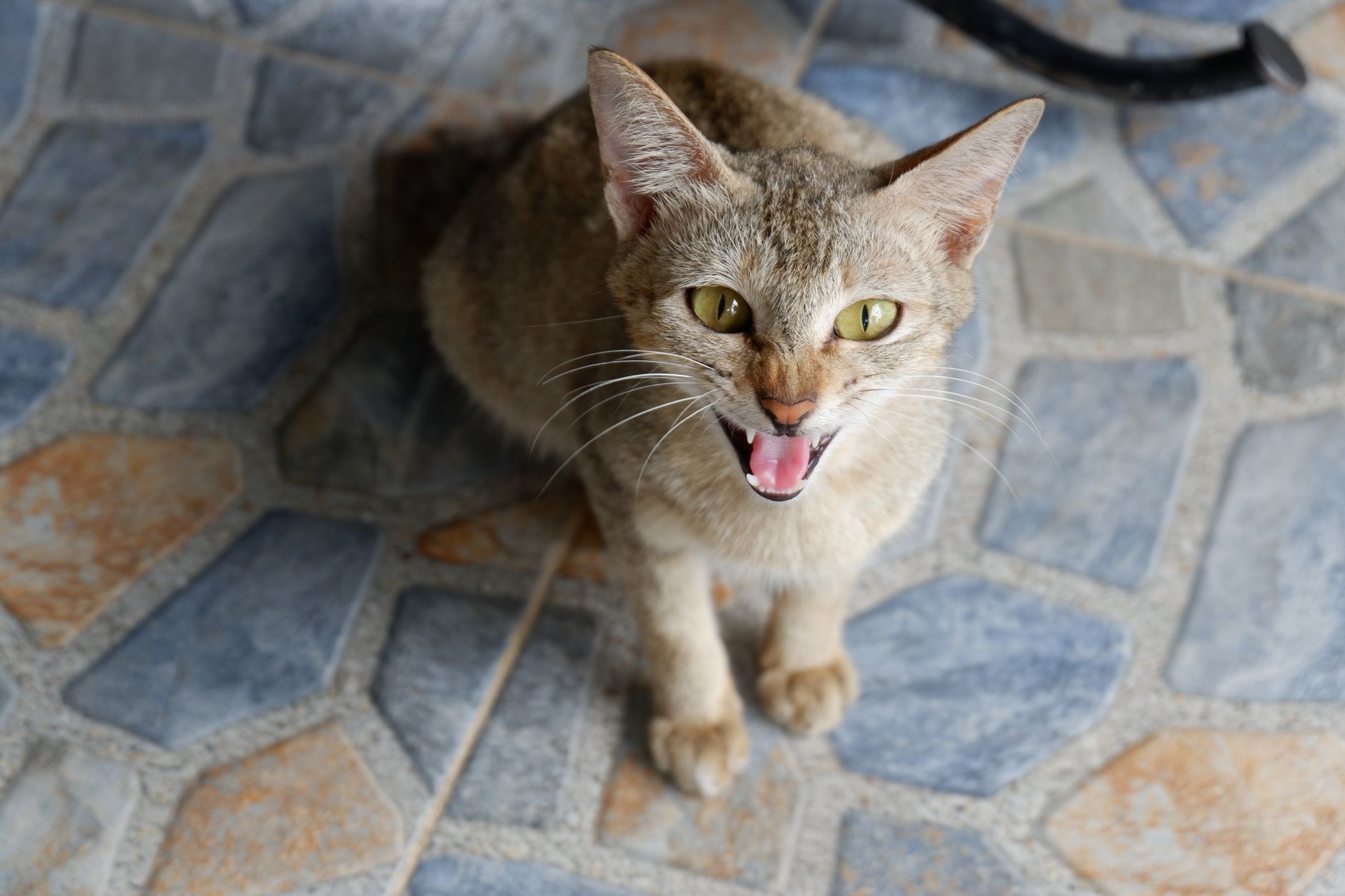
Hello, it’s Sachat! You know that moment when your cat is purring on your lap, then sinks his claws into your hand a second later? Or when he hisses, fur bristling, the moment another moggy walks past the window? Let me reassure you straight away: an aggressive cat is almost never a “nasty” cat. It’s a cat who’s trying to tell you something, and he does it with the only tools he has, namely his teeth and his claws. My job today is to teach you to decode these signals and turn your little wild beast into a zen ball of fur. Follow me, I’ll show you everything.
What exactly is aggression in cats?
First thing to understand: aggression in cats is a behaviour, not a personality. No kitten is born thinking, “I’m going to make my human’s life a misery”. When we scratch or bite, it’s because we have a good reason in our eyes, even if it seems absurd to you.
With us felines, aggression serves above all to create distance. You come too close, you touch a sensitive area, you corner me: I don’t have the words to tell you, “step back, please”, so I use my body. And believe me, we almost always warn before acting. The trouble is that humans don’t read our warning signals.
The signals that herald the storm
Before scratching you, I send you a series of messages. Learn them by heart: tail lashing from left to right, ears flattened back (aeroplane mode), dilated pupils, arched back, bristling fur, and that famous low growl. If you see this and carry on with the cuddles, you’re asking for trouble! The right response: you stop dead and give me some space.
The main causes of feline aggression
We don’t turn snappy by chance. Here are the most common triggers, the ones I see all the time around me.
Fear and stress
This is cause number one, by a long way. A frightened cat who can’t flee will attack, it’s pure survival. A house move, a new baby, noisy building work, a stranger in the home: any change can put us on edge. An unstable environment makes for a cat on a knife’s edge.
Redirected aggression
This one is sneaky. I catch sight of an enemy cat through the window, I’m boiling with frustration because I can’t face him, and… it’s you walking by at the wrong moment who cops it. It’s not your fault, but my anger has been redirected onto the first available target. Frustrating for us both.
Badly channelled play
If you played with my paws and your hands when I was a kitten, don’t be surprised that I bite your fingers today. To me, your hand IS the toy. A cat brimming with energy and no outlet quickly becomes a little delinquent who pounces on your calves.
Pain and illness
A very important point, and I’m cautious here: a normally cuddly cat who suddenly becomes aggressive may well be hurting somewhere. Arthritis, a dental problem, an ear infection, a hidden pain… We mask suffering by instinct, and sometimes it comes out as irritability. If the change in behaviour is abrupt, don’t overthink it: off to the vet to rule out any medical cause. They alone can make a diagnosis.
My tomcat tricks to calm an aggressive cat
Good news: in the vast majority of cases, all of this can be defused. Here’s my action plan, tested and approved by my paw pads.
Create a territory that reassures
A cat feels safe when he has height and refuges. The perch is sacred: from up there, I observe without feeling threatened, and I can withdraw when a human gets too clingy. A good cat tree with platforms – Amazon really changes things for an anxious moggy. It gives me a space all my own, and a place to scratch without ruining your sofa, which already eases a fair amount of tension.
Burn off my energy every day
A tired cat is a happy cat. Ten to fifteen minutes of active play a day works wonders on aggression linked to frustration. The idea: get me chasing, leaping, running, so I let out the surplus energy on prey and not on your ankle. Always keep a natural ball for cats – Amazon within paw’s reach, it lets me play on my own when you’re not there. And the golden rule: we NEVER play with bare hands. Always a toy between your fingers and my teeth.
Soothe my stress with pheromones
When the air in the home is tense, a chemical helping hand goes a long way. Calming pheromones copy the ones a mother cat produces to reassure her kittens. A Feliway pheromone diffuser – Amazon plugged into the room where I spend the most time creates an “all is well” mood that genuinely calms nervous cats. It isn’t magic, but combined with the rest, it really sets the atmosphere, especially after a house move or the arrival of a newcomer.
The mistakes never to make
If you remember only one thing, let it be this one: you never punish an aggressive cat. Shouting, hitting, spraying with water, grabbing by the scruff: all of that only increases my fear, and so my aggression. You’re just confirming that you’re a threat. As a result, I have even more reasons to scratch you.
Another mistake: forcing contact. If I hide, let me come to you when I’m ready. The more you chase me for cuddles, the more I dig my heels in. Respecting my pace is the foundation of our relationship.
Finally, don’t play down a sudden change. A gentle cat who abruptly turns snappy isn’t being “difficult”, he probably has a health issue or significant stress that you haven’t spotted. Observe, note what has changed for us, and never hesitate to ask a professional for their view.
FAQ
My cat bites me during cuddles, why?
It’s what we call petting intolerance. After a while, the contact becomes too stimulating, even unpleasant for me, and I tell you so with my teeth. Watch my tail and my ears: as soon as they start twitching, stop stroking me before I act. Favour the areas I adore, the chin and the cheeks, and avoid the belly and the base of the tail.
How do you calm two cats who are fighting?
Never put your hands between us, you’d end up in A&E. Separate us with a loud noise or an object (a piece of cardboard between the two) then isolate us in different rooms while we come back down. Then reintroduce us very gradually and make sure we each have our own resources: separate bowls, litter trays and perches to avoid competition.
Can an aggressive cat become gentle again?
Yes, in the vast majority of cases! Aggression is a symptom, not a life sentence. Once the cause is identified and dealt with (stress, pain, boredom), the behaviour settles down. It takes patience and consistency, but a cat who’s comfortable in his paw pads becomes the affectionate companion he’s always been at heart.
When should you see the vet about your cat’s aggression?
See a vet as soon as the aggression appears suddenly, intensifies, or comes with other signs (loss of appetite, listlessness, changes in toileting). They alone can rule out a medical cause and, if needed, refer you to a feline behaviourist. Better an exam for nothing than letting a hidden pain drag on.
Purrs, Sachat 🐾